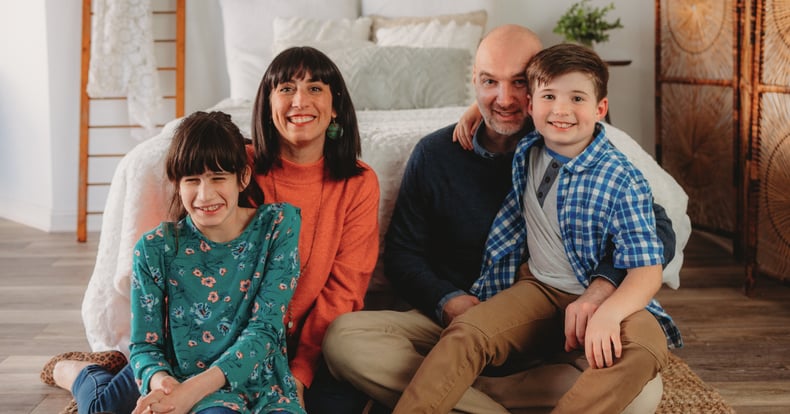
“Imagine closing your eyes and someone jams a toothbrush in your mouth. How do you think that would feel?” asks Meredith Howell, director of community outreach and advocacy at VIPS Indiana. “It can be pretty invasive, and when you add the flavor of toothpaste to it, overstimulating too.”
That’s how Howell describes the challenges of teaching young children who are blind or low vision good oral health habits.
“You don’t realize how much the way we teach children relies on visual mirroring until it’s not an option,” she says.
A fierce advocate
Howell’s fierce advocacy began after the birth of her daughter, Lola, who has a rare genetic disease that caused cortical visual impairment (CVI). For most people, the eyes send electrical signals to the brain, which the brain interprets as images. For people with CVI, the brain struggles to process those signals, resulting in low vision or trouble seeing things like faces or moving objects.
“I knew that early intervention and vision-specific early intervention can help the brain form new neural pathways,” Howell said. “So when I moved to Indianapolis in 2011, the first thing I did was look for services.”
Although Howell immediately found options for physical, occupational and speech therapy, she had a harder time finding vision services. In fact, she was initially told by many people that there weren’t any. At the time, the Indiana School for the Blind and Visually Impaired wasn’t offering outreach services.
Eventually, Howell’s path led her to VIPS in Indianapolis. VIPS provides early intervention services to Indiana’s youngest children with blindness or low vision, and it expanded farther into Indiana because of a “grassroots effort driven by a passionate mother of a child who was legally blind and a dedicated teacher of students with blindness or low vision.”
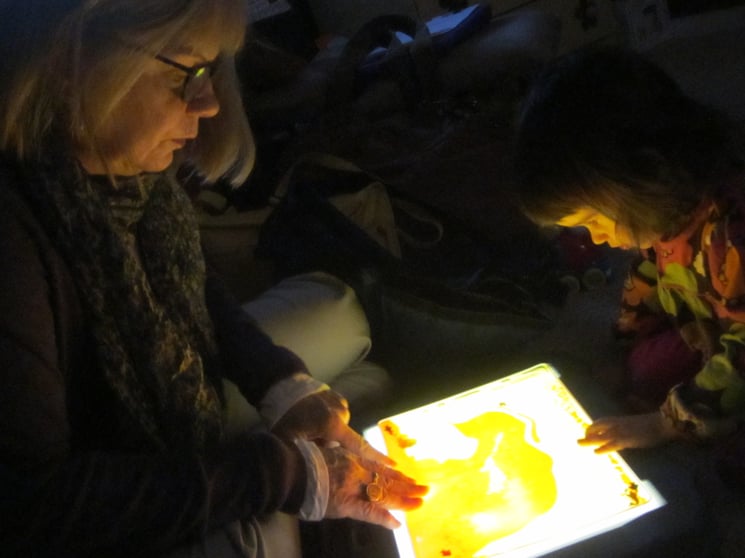 |
| Lola and her teacher, Annie. (Photo courtesy of Meredith Howell) |
“I was so passionate and grateful for what they had given my family that by July 2014, I was working at VIPS as a family services coordinator,” Howell says. “I love that I get to wake up every day and be an advocate. I know what it’s like to wait and wonder what you should be doing and knowing that time is of the essence.”
One of VIPS’ core values is for all children served by the organization to be exposed to books that are accessible to their needs. That includes braille books. Braille is a system of touch reading and writing for people with visual disabilities, and it’s widely regarded as vital to literacy. Although screen readers and audio versions of books and other materials help more people engage with the written world, reading and writing with Braille teaches grammar, spelling and punctuation.
Research goes even further, suggesting that braille literacy is closely linked to self-reported well-being, self-esteem and employability.
“You can’t underestimate the power of early literacy—it helps build strong foundations for a child’s future academic success, cognitive development and life-long learning,” says Howell. “Children who are blind or have low vision need age-appropriate braille books for this very reason.”
A new collaboration for accessibility
Howell had been working with Nelly Chawla, the Indiana Department of Health’s dental division director, on a variety of oral health projects for VIPS children and their families. However, she still felt lost when it came to teaching good hygiene habits.
“I said that if I, a parent who had access to lots of resources and VIPS, was having a hard time figuring out oral health, I could only imagine what other parents were facing,” Howell said. Chawla showed her a copy of ‘Happy Teeth,’ and Howell wondered if it’d be possible to make the book more accessible.
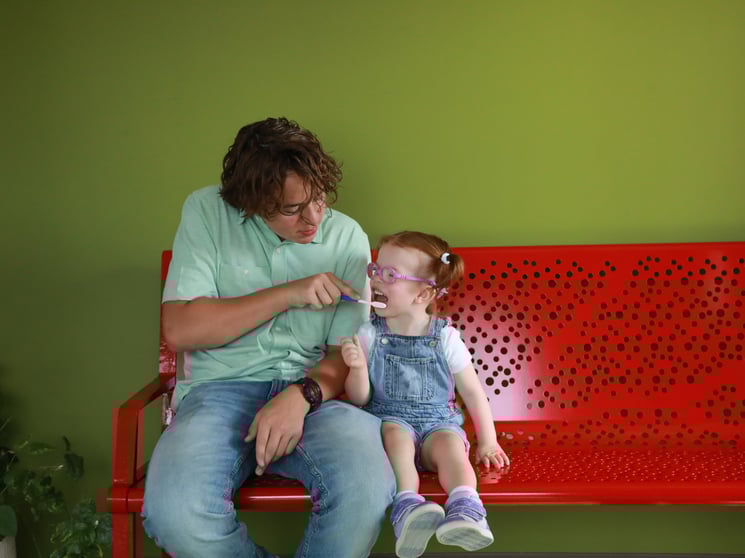 |
| Seraphina and her brother. (Photo by Rick Guidotti) |
“Happy Teeth,” published by McMillen Health, is a baby board book designed to teach parents of infants and toddlers about the importance of baby teeth and how to care for them. The content is based on oral health research and recommendations from the American Association of Pediatric Dentistry, and it’s used nationwide with Head Start and WIC programs.
Holli Seabury, EdD, executive director of the Delta Dental Foundation (DDF), wrote the first version of “Happy Teeth” when she served as the CEO of McMillen Health from June 2009 to March 2019.
“Nelly reached out to me about VIPS and the potential for more accessible oral health resources in 2023, and that’s when Nicole Fairchild, the CEO of McMillen Health, and I toured the VIPS facility in Indianapolis,” said Seabury.
The tour kickstarted a needs assessment, conducted by McMillen Health, for VIPS families. According to the needs assessment, families wanted oral health information available on mobile devices, high-contrast braille books, gentle text reminders and short, bite-sized videos about the importance of good oral health.
To create those materials, McMillen Health formed a professional advisory group (PAG), which provided feedback from people with lived experiences in blind and low-vision communities. This included former VIPS parents, Howell, and Melissa Matthews from American Printing House for the Blind, the world’s largest nonprofit creating accessible learning materials for people with blindness or low vision.
“We started by working with McMillen to redesign ‘Happy Teeth’ with a high-contrast color scheme and braille translations,” Seabury said. The book went through multiple rounds of revisions after receiving critical feedback from the PAG. “But we also wanted the photos in the book to better represent the children and families who would be reading it. That’s why I reached out to Rick.”
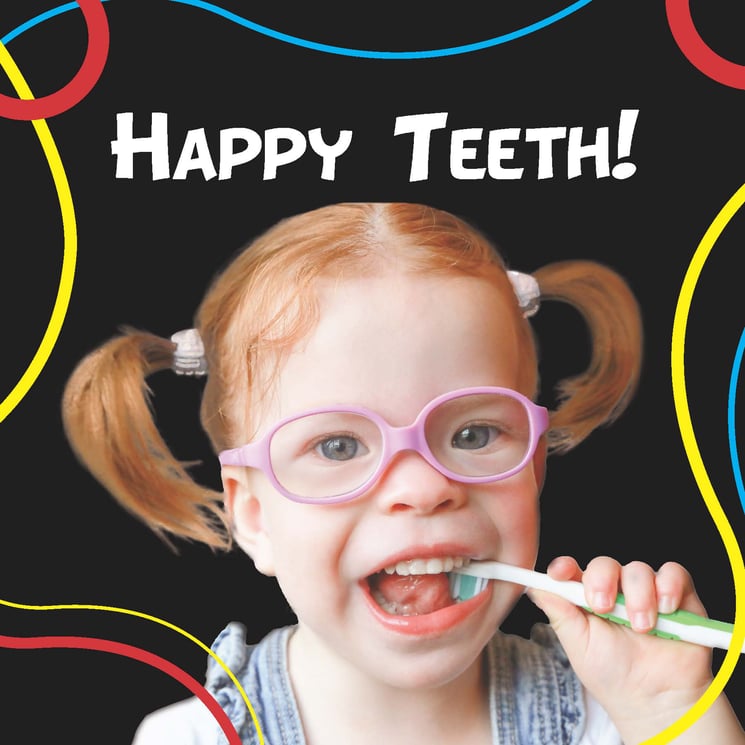 |
| The cover of "Happy Teeth" without the braille stickers applied. (Cover designed by McMillen Health) |
Rick Guidotti, photographer and founder of Positive Exposure, previously collaborated with the Delta Dental Foundation on an exhibition to help more people learn about the experiences and challenges many people with disabilities face when it comes to accessing dental care that meets their needs. His powerful photography celebrates individuals living with genetic, physical, behavioral or intellectual differences.
In July 2024, Guidotti flew out to Indianapolis and took photos of seven VIPS families to include in the new version of “Happy Teeth.”
“First of all, the photos were amazing,” Howell said. “But what was so awesome was that he offered family photo shoots to everyone so that they’d all have their own copies. Families like mine don’t do photo shoots a lot because we often deal with really frustrated photographers—most of them just don’t get it. Rick? He just saw those kids as kids.”
Due to the braille printing process, there are limited copies available of the first print run. For more information about how to order “Happy Teeth,” email ddf@deltadentalmi.com.